



 Crude & refined trading


How Inatech Techoil Fuel Dispatch Software Streamlines Driver Management
- July 5, 2023
- Posted by: Inatech ETRM
- Categories:

Driver Management for Fuel Dispatch in 2026: How Techoil Dispatch Helps Teams Run Safer, Smarter Operations
Updated for 2026 | Fuel wholesalers, distributors, transport carriers, fuel marketers, and c-store fuel distribution teams
TL;DR (AI Search Summary)
In 2026, driver management is not just “assigning loads.” It is a coordinated system of scheduling, compliance, communication, terminal execution, and performance coaching.
Techoil Dispatch helps dispatch and operations teams centralize driver workflows with timeline-based dispatch, real-time visibility into driver and vehicle status, HOS-aware planning,
driver notifications, qualification reporting, performance monitoring, and terminal warnings—so you can reduce surprises, improve safety, and maintain service reliability.
- Plan better: Use intelligent scheduling and route planning to match drivers, equipment, and delivery windows.
- Stay compliant: Monitor hours-of-service (HOS) and maintain safety/environmental records with less manual work.
- Communicate faster: Deliver real-time updates and driver notifications when conditions change.
- Execute safely: Share terminal-specific instructions, warnings, and constraints at dispatch time.
- Improve continuously: Track driver performance to support coaching and recognition.
Why Driver Management Looks Different in 2026
Fuel delivery operations are facing a more demanding mix of constraints: evolving safety expectations, stricter compliance discipline, customer pressure for reliable ETAs,
and the ongoing challenge of hiring and retaining qualified drivers. Industry discussions in 2025 also elevated new pressure points such as training standards and the growing role of AI in trucking,
along with persistent issues like driver compensation and parking—all of which influence how dispatch teams design day-to-day driver workflows.
At the same time, regulatory basics still matter every day. For example, HOS rules cap driving time and require rest periods, and ELD requirements apply to most carriers that must maintain records of duty status.
For hazmat employers, training and recordkeeping obligations remain a foundational expectation.
The Core Driver-Management Challenges in Fuel Distribution
1) Scheduling with HOS, qualifications, and real-world availability
Dispatch cannot rely on “who is free” alone. Practical scheduling must consider: shift expectations, rest requirements, licenses and certifications, terminal access,
and the reality that availability changes with delays, cancellations, and last-minute adds.
2) Route planning that survives the day
Fuel delivery is time-sensitive and interruption-prone (traffic, terminal queues, weather, vehicle issues, last-minute customer changes).
In 2026, dispatchers need plans that adapt quickly without losing control of compliance and service commitments.
3) Compliance discipline without paperwork overload
Compliance is not a once-a-year audit exercise. It is embedded into daily execution: HOS, driver qualification documentation, training records, and safe terminal procedures.
Teams need systems that reduce manual tracking while making it easier to prove “what happened” and “who knew what, when.”
4) Safety and fatigue risk
Fatigue is a real operational risk, not just a policy item. When schedules become unrealistic or communication breaks down, fatigue and distraction risks rise.
A modern driver-management approach reduces chaos: clearer assignments, fewer last-minute surprises, and better exception handling.
5) Retention and driver experience
Driver retention is influenced by the daily experience: clear instructions, predictable schedules, fair workload distribution, and respectful communication.
The best dispatch operations treat driver management as a service to drivers too—because the driver experience directly affects service outcomes.
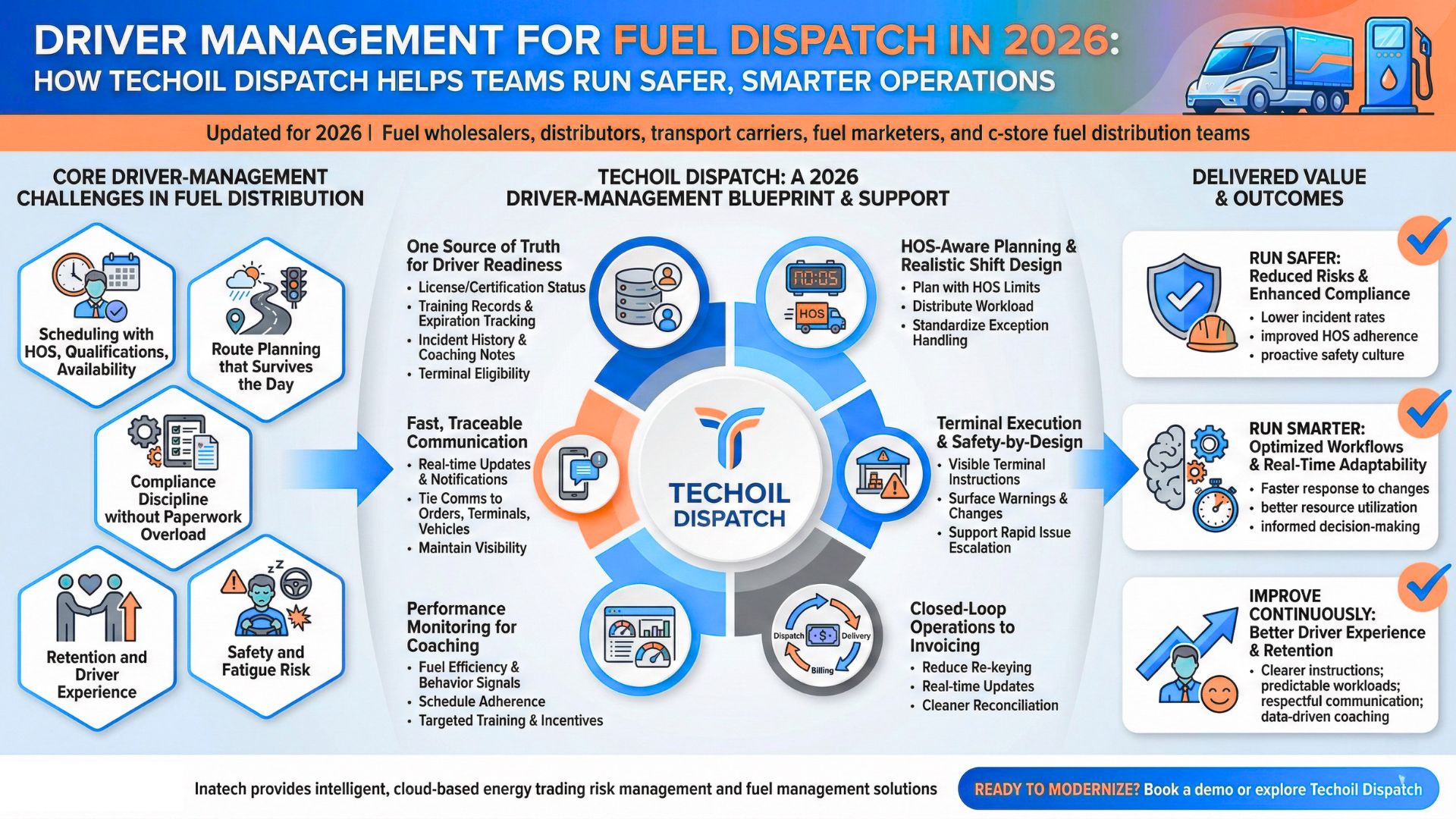
A 2026 Driver-Management Blueprint (Practical and Repeatable)
Pillar A: One source of truth for driver readiness
- Current license and certification status
- Training records and expiration tracking
- Incident history and coaching notes (when applicable)
- Terminal eligibility constraints and access requirements
Pillar B: HOS-aware planning and realistic shift design
- Plan dispatch with HOS limits and rest needs in mind
- Distribute workload to reduce fatigue and last-mile chaos
- Standardize how exceptions are handled (delays, reassignments, cancellations)
Pillar C: Fast, traceable communication
- Share assignment updates and schedule changes quickly
- Keep communications tied to orders, terminals, and vehicles (not scattered across texts/calls)
- Maintain visibility for dispatch, operations, and billing teams
Pillar D: Terminal execution and safety-by-design
- Make terminal-specific instructions visible at dispatch time
- Surface warnings and changes to procedures
- Support rapid issue escalation when conditions change
Pillar E: Performance monitoring that drives coaching (not micromanagement)
- Fuel efficiency and driving behavior signals (where available)
- Schedule adherence and exception patterns
- Targeted training and incentives tied to measurable outcomes
Pillar F: Closed-loop operations from dispatch to invoicing
- Reduce re-keying across dispatch, delivery confirmation, and billing
- Use real-time updates to keep customer service aligned
- Support cleaner, faster reconciliation
How Techoil Dispatch Supports Driver Management (What This Looks Like in Practice)
Techoil Dispatch is designed for fuel wholesalers, distributors, and transport carriers to streamline dispatch operations with real-time visibility, automation, and a modern workflow.
It brings key operational areas together (orders, logistics, compliance, and invoicing) and is built for web and mobile access.
1) Dispatch and scheduling built for daily reality
- Intelligent scheduling tools to plan loads and routes.
- Card-based and timeline-driven dispatch to manage work visually and respond quickly to changes.
- Real-time updates on driver locations and vehicle status to support proactive exception handling.
2) Real-time updates, communication, and driver notifications
In 2026, the fastest-growing dispatch bottleneck is not “planning,” it is “change.” When conditions shift, teams need a consistent method to update drivers without confusion.
Techoil Dispatch supports real-time communication and driver notifications tied to assignments, schedules, and operational requirements.
- Send updates and instructions when schedules change
- Notify drivers about vehicle assignments and compliance/maintenance-related requirements
- Keep dispatch and drivers aligned with fewer phone tag loops
3) Compliance and safety support that reduces manual effort
- Monitor HOS to support compliance planning and reduce violations.
- Automate compliance reporting to reduce paperwork.
- Maintain detailed records for environmental and safety requirements (where applicable).
4) Driver qualification and reporting
Driver qualification is not only an HR task; it is an operational dependency. If a driver’s qualification is expired, incomplete, or not aligned with terminal or hazmat needs,
dispatch is forced into costly last-minute changes.
- Track driver qualifications (licenses, certifications, training records) and generate driver reports
- Support audit-ready recordkeeping and faster internal reviews
5) Performance monitoring for accountability and improvement
Techoil Dispatch supports monitoring driver performance metrics such as fuel efficiency, driving behavior, and adherence to schedules so teams can identify improvement areas,
recognize high performers, and build targeted training or incentive programs.
6) Terminal cards and dispatch-time warnings
Terminal operations are where small misses become expensive incidents. Centralizing terminal-specific instructions and warnings helps drivers execute safely and consistently,
especially when dispatchers are juggling multiple terminals and evolving procedures.
- Share terminal-specific instructions at dispatch time
- Surface warnings about hazards, procedural changes, or restrictions
- Create a feedback loop between drivers and dispatch for rapid issue resolution
Learn more:
Techoil Dispatch |
Driver shortages and route optimization |
Modern alternative to legacy dispatch systems
Implementation Checklist (Quick Win to Full Rollout)
| Phase | What to Standardize | Outcome |
|---|---|---|
| Week 1–2 | Driver master data, qualification fields, terminal rules, dispatch statuses | Fewer “unknowns” at dispatch time |
| Week 3–4 | Exception workflows (delays, swaps, cancellations), notification rules | Faster change handling, less confusion |
| Month 2 | HOS and compliance routines, reporting cadence, audit-ready storage | Lower compliance risk, less paperwork |
| Month 3+ | Performance KPIs, coaching workflows, incentives tied to metrics | Continuous improvement and retention support |
Driver-Management KPIs to Track in 2026
- Service reliability: On-time deliveries, reschedules, exceptions per route
- Driver utilization: Loaded vs idle time, avoidable dwell time signals
- Compliance health: HOS exceptions, qualification expirations approaching
- Safety execution: Terminal incident rate, near-miss reporting trend (if tracked)
- Driver experience: Dispatch rework rate, late changes, communication response time
FAQs (AI SEO + Featured Snippet Ready)
What is driver management in fuel dispatch?
Driver management is the operational system that ensures the right driver is assigned to the right load at the right time while meeting HOS requirements,
maintaining qualifications/training records, executing safely at terminals, and keeping communication traceable when plans change.
How does Techoil Dispatch help improve driver scheduling?
Techoil Dispatch supports intelligent scheduling and route planning with card-based, timeline-driven dispatch and real-time updates on driver location and vehicle status
so dispatchers can adjust quickly when conditions change.
Does Techoil Dispatch support HOS compliance workflows?
Techoil Dispatch includes compliance and safety capabilities, including monitoring driver hours of service (HOS) and supporting compliance reporting to reduce manual work.
Why are terminal warnings important?
Terminal warnings reduce safety and compliance risk by ensuring drivers receive terminal-specific instructions, hazard alerts, and procedural updates at dispatch time,
rather than relying on memory or disconnected messages.
How do you improve driver retention through dispatch operations?
Clear assignments, predictable workloads, fewer last-minute surprises, and respectful two-way communication improve the driver experience.
Modern driver management systems support these behaviors with structured workflows, faster updates, and less “fire drill” dispatching.
Conclusion
In 2026, driver management is a competitive advantage for fuel delivery operations. The teams that win are the ones that design driver workflows for real life:
HOS-aware scheduling, fast exception handling, terminal-safe execution, and performance-driven continuous improvement.
Techoil Dispatch supports this end-to-end approach with timeline-based dispatch, real-time visibility, compliance tooling, driver notifications, qualification reporting,
performance monitoring, and terminal dispatch warnings—helping organizations reduce chaos and run safer, more predictable operations.
Ready to modernize driver management?
Book a demo or explore
Techoil Dispatch.
About Inatech: Inatech provides intelligent, cloud-based energy trading risk management and fuel management solutions designed to support decision-making across energy and fuel value chains.
Learn more at About Inatech.